Overview
As Berlin's Mies van der Rohe Haus approaches its centennial, a new curatorial vision takes hold. "What's going on?" marks director Dennis Brzek's inaugural exhibition, a seven-artist group show that deliberately unsettles the architectural monument's carefully constructed present. Running from March 29 through July 26, 2026, the exhibition asks a deceptively simple question: what does it mean to exhibit art in a building that is itself a painstakingly reconstructed work of art?
The timing is deliberate. Over decades of misuse—first as a Red Army garage, later as a Stasi laundry and storage facility—Haus Lemke deteriorated. Only through meticulous restoration between 2000 and 2002 did it reclaim its status as an architectural landmark. Yet that restoration created a paradox: the building now exists in a state of temporal suspension, a "fiction" reconstructed from archival material and "restored with contemporary means as faithfully as possible." Brzek's exhibition inhabits this contradiction, using contemporary artistic practice to expose what the restoration concealed.
The Artist
Dennis Brzek brings a curatorial philosophy shaped by engagement with historically charged sites. Before assuming directorship at Mies van der Rohe Haus in December 2025, Brzek worked as curator at Fluentum in Berlin, where he developed exhibitions addressing how memory attaches itself to physical spaces and how history appears in the present moment. His background as both curator and writer positions him to ask searching questions about institutional identity and the relationship between artistic practice and site specificity.
Brzek's vision for Mies van der Rohe Haus marks a departure from treating the building as a static monument. Instead, he proposes it as "a living architectural monument, an exhibition space for contemporary art and an open meeting place for the city and neighbourhood." This philosophy permeates "What's going on?," which treats the house not as a pristine container but as an active participant in the exhibition's meaning.
Key Works to Look For
Dora Budor's "Nicotine Museum" is perhaps the exhibition's most conceptually audacious work. Using stage-set pigment to simulate rooms discolored by cigarette smoke, Budor outlines traces of former furniture on Haus Lemke's walls. The work materializes absence itself—not depicting what was lost, but showing the marks it left behind. In a building whose entire interior was stripped and replaced during restoration, Budor's ghost furniture becomes a meditation on what restoration erases.
Tam Ochiai's sketches of Mies van der Rohe buildings "daydreaming" introduce playfulness into the exhibition's otherwise serious inquiry. By anthropomorphizing the architect's iconic structures, Ochiai opens modernism's austere language to fantasy and humor, suggesting that even canonical architecture contains emotional and imaginative dimensions beyond its formal purity.
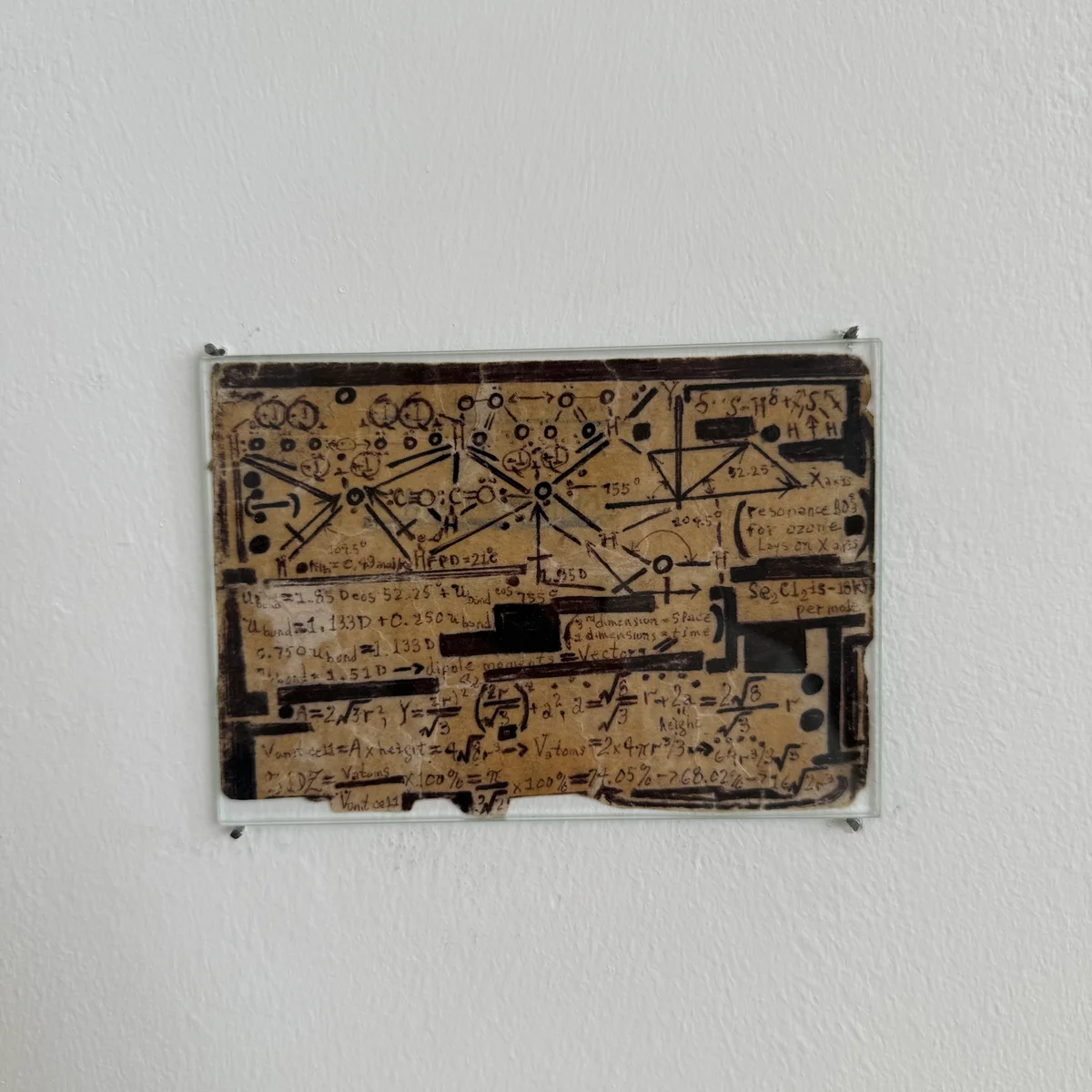
Melvin Way's compact drawings, produced painstakingly over months, represent obsessive investigation into natural systems and scientific language. These works' intensive labor stands in striking contrast to the exhibition's broader concern with temporal flow and loss—Way's methodical approach suggesting that meaning-making requires sustained attention even as time erodes and memory fades.
Samuel Jeffery, Clara Hausmann, Oliver Tirré, and Constantina Zavitsanos round out the exhibition with site-responsive interventions that collectively address absence, memory, and the threshold between presence and loss.
Why It Matters
"What's going on?" arrives at a crucial moment for architectural heritage in Europe. As cities grapple with preserving modernist structures, institutions face persistent questions: Should restoration aim for historical accuracy or acknowledge the inevitable alterations time imposes? Can a monument simultaneously be a living space for contemporary practice?
The exhibition's curatorial strategy is particularly significant. Rather than displaying contemporary art within a restored monument (the conventional approach), Brzek positions contemporary artists as collaborators in interrogating the monument's status itself. When Dora Budor simulates cigarette stains on walls that were meticulously cleaned, she's not merely creating an artwork—she's asking whether restoration that erases all traces of habitation serves historical understanding or obscures it.
This approach reflects broader shifts in how we understand cultural memory. The exhibition acknowledges that Haus Lemke's present form is contingent, shaped by specific archival decisions and restoration priorities. By making contemporary artistic practice central to interpretation, Brzek suggests that meaning emerges through ongoing dialogue with sites rather than through sealed historical reconstruction.
The exhibition also speaks to Berlin's particular historical complexity. A building that sheltered a prominent printing family, then housed Nazi occupation, Soviet confiscation, and Stasi surveillance before becoming a public monument embodies layers of memory that no single restoration can contain. Contemporary art becomes a language for articulating this complexity without resolving it.
Visitor Info
Mies van der Rohe Haus is located at Oberseestraße 60 in Berlin's Alt-Hohenschönhausen district, directly adjacent to the Obersee lake with park access. The venue is accessible by tram: take lines 27 or M4 to the Am Faulen See stop. The exhibition opens March 28, 2026 (4–9 pm) and runs through July 26, 2026.
Brzek's inaugural program extends beyond the main exhibition. "Open House," an event series running August 4 through September 6, 2026, will feature temporary artist interventions extending into the garden. An accompanying podcast series and artist-curated mixtapes will emphasize sound's role in experiencing the site. Educational programming, including workshops with young adults exploring active approaches to art and language, will deepen public engagement.
The 2026 program is supported by the Karin und Uwe Hollweg Stiftung and receives base funding from Bezirksamt Lichtenberg. A publication—a comprehensive exhibition booklet—will be available, along with a detailed floor plan.
For those seeking deeper understanding of the house's architectural significance, guided tours titled "Understanding Mies" take place the first Sunday of each month at 11:30 am (€5 per person).