Overview
Tomorrow, I Become a Woman is a searing and intimate exhibition that confronts the erasure of women's experiences in militarized histories. South African artist Teresa Kutala Firmino presents thirteen mixed media paintings that transform personal and collective trauma into vivid, defiant visual testimony. Housed in the prestigious Galerie Nagel Draxler in Cologne from March to May 2026, this exhibition stakes a claim for the stories of Buffalo women whose childhoods were fractured by war, displacement, and gendered violence.
The Artist
Tereza Kutala Firmino, born in 1993 in Pomfret—a desert town settled by former soldiers of the 32 Battalion after Angola's civil war—carries a complex inherited history. With a Congolese father and Angolan mother, she inherited the displacement trauma of both sides of her family. Her practice, rooted in research and storytelling, operates as an act of archival resistance. As she articulates: "We heal by retelling our stories."
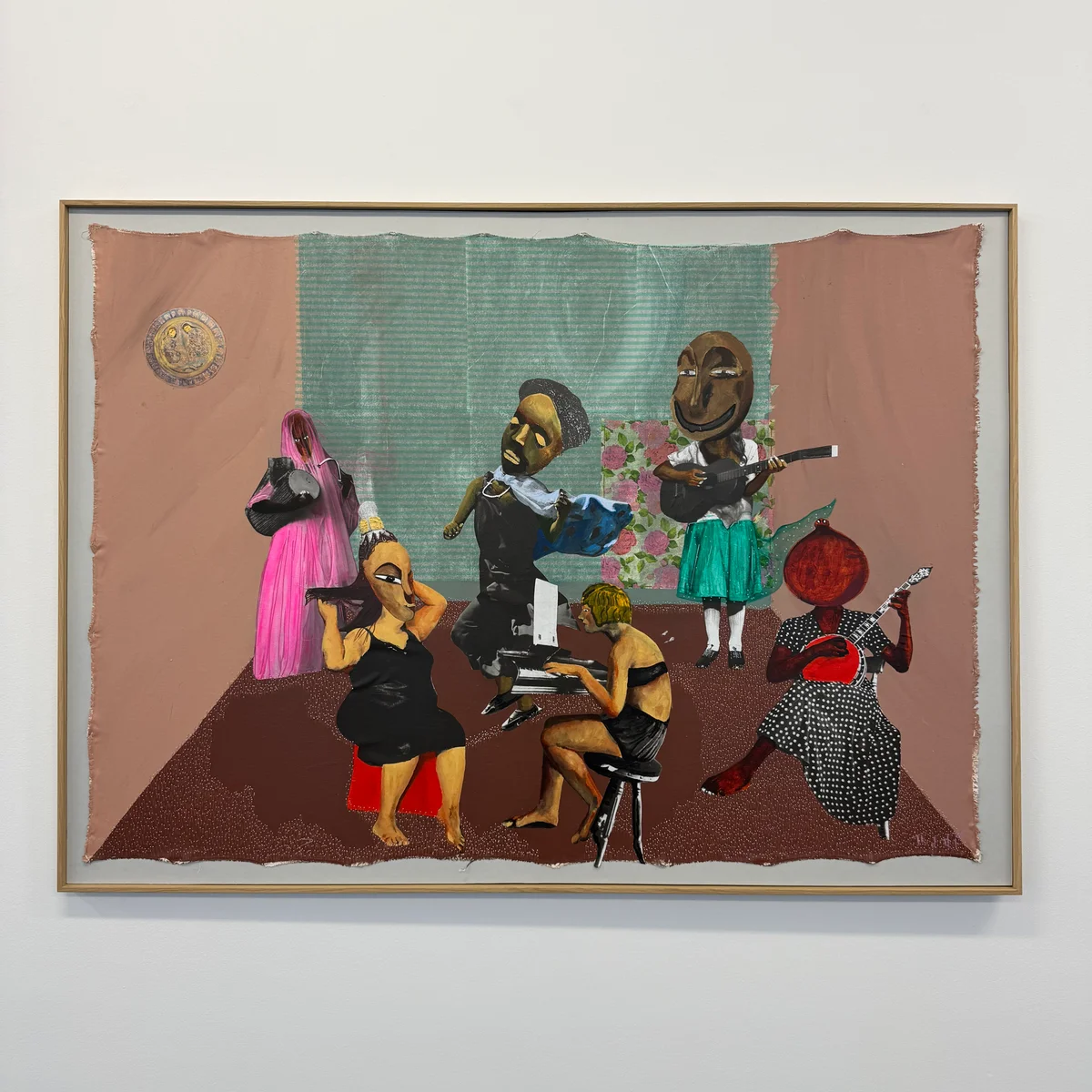
Firmino's methodology is meticulous and layered. She collects imagery from magazines, newspapers, historical documents, and social media, constructing surreally baroque domestic interiors where figures can reclaim agency over their narratives. Her works negotiate both personal and collective trauma through constructed scenes where past and present intertwine. Based in Johannesburg, she works across multiple mediums—painting, photography, and performance—creating alternative African histories that challenge official historical records.
Key Works to Look For
The exhibition's thirteen paintings, all created in 2025, operate as both individual statements and collective testimony. Titles like "Ritual of becoming," "quiet refusal," and "dreaming resistance" suggest psychological and political acts of reclamation. Larger canvases such as "Silent Choir" (118 x 166.5 cm) and "Against the quiet" (129 x 139 cm) dominate the space with their scale, refusing the marginalization these women experienced in official histories.
Works like "A girls posture" and "G for Gun girl" directly address the militarization of femininity, while "Blue Mothers," "Shadows in powder blue," and "between vulnerability and light" gesture toward intimate domestic spaces where survival strategies were learned and passed down. The color palette and compositional choices—box-like stages, tightly confined interiors—create spaces of psychological intensity that mirror the constrained lives these works commemorate.
Why It Matters
This exhibition arrives at a critical moment for African contemporary art and feminist historiography. Firmino challenges dominant narratives that position women as peripheral witnesses to war rather than as subjects whose "constrained futures, strategies of survival, and modes of resistance form an essential archive of the region's militarised past."
Becoming a woman, as Firmino frames it, is not a gentle biological transition but an "abrupt crossing, marked by displacement, militarised landscapes, and the unspoken violences that threaded through daily life during and after the conflict." Yet the exhibition resists victimization. Within the stillness of these paintings, figures insist on something more: futures not defined by the battalion's legacy, but by their own remembering, reconstruction, and imagination.
The work centers interiority as an act of resistance—what women thought, felt, and imagined even when their bodies were read through political lenses. The domestic interior becomes a site where military and patriarchal logics converge, but also where women strategize, dream, and refuse silence.
Firmino's practice also intervenes in how African histories are preserved and told. By creating an alternative archive, she counters the erasure of women's experiences from official histories and asserts that healing comes through retelling our stories—claiming narrative authority over one's own past.
Visitor Info
Exhibition: Tomorrow, I Become a Woman
Artist: Teresa Kutala Firmino
Venue: Galerie Nagel Draxler, Elisenstraße 4-6, 50667 Cologne, Germany
Dates: March 13 – May 13, 2026
Opening Reception: Thursday, March 12, 2026, 6–9 PM
Hours: Wednesday–Friday 11 AM–6 PM, Saturday 11 AM–4 PM
Phone: +49 (0)221 99783229
Web: nagel-draxler.de