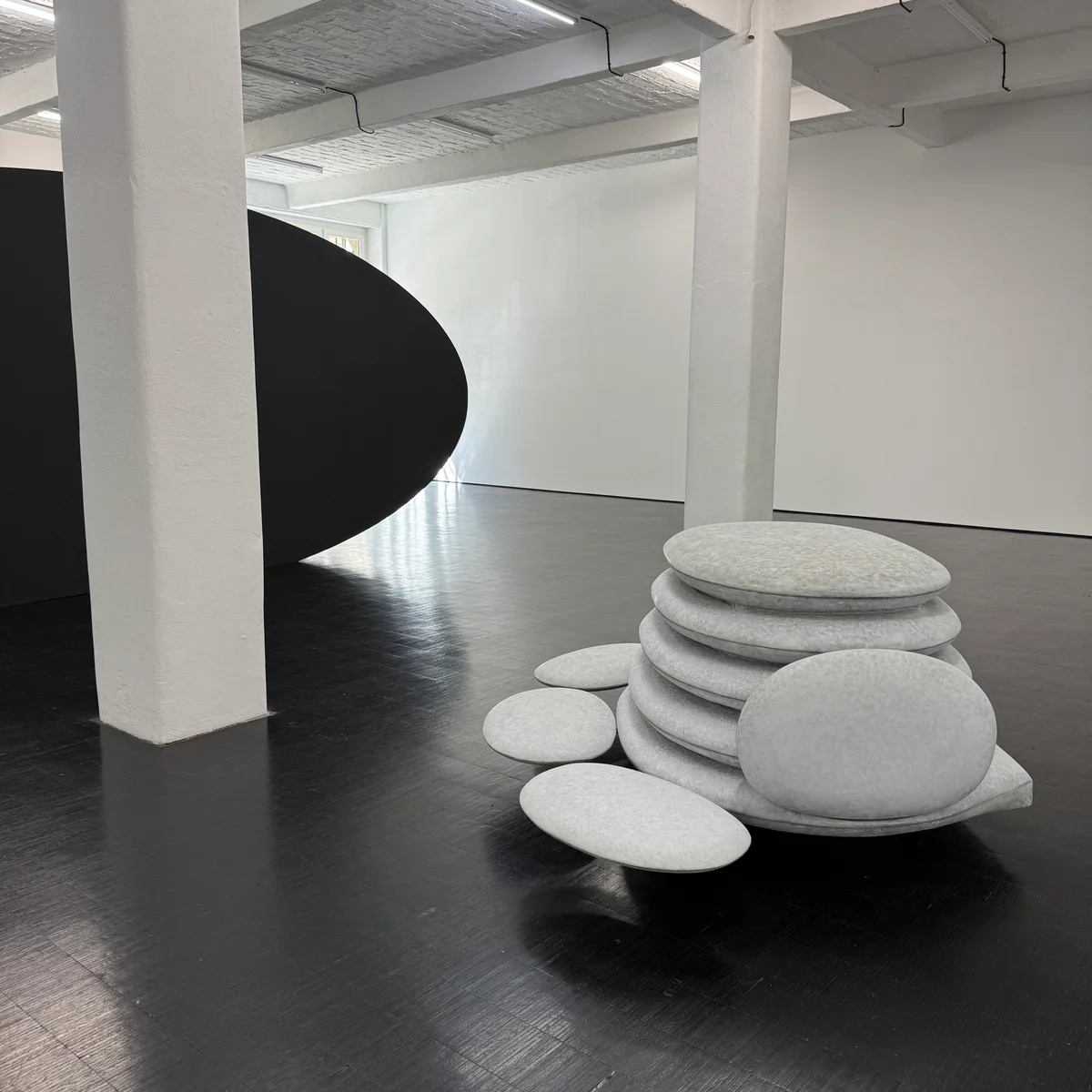
Overview
Stella Zhong's inaugural German solo exhibition arrives at Trautwein Herleth as part of Gallery Weekend Berlin 2026, one of Europe's most significant contemporary art events. Running from May 1 through June 13, the show introduces Berlin audiences to an artist whose practice operates at the intersection of sculpture, installation, video, and painting—mediums she deploys to construct what the artist herself calls "hermetic worlds."
Zhong's work doesn't announce itself with conventional gestures. Instead, it whispers from multiple scales simultaneously, forcing viewers into a vertiginous negotiation between the monumental and the infinitesimal. This exhibition asks us to recalibrate our perceptual apparatus, to feel the productive discomfort of not quite knowing how to read what we're looking at.
The Artist
Born in Shenzhen in 1993, Zhong studied glass at the Rhode Island School of Design before earning her MFA from Yale. Based now in Brooklyn, she's exhibited at Para Site in Hong Kong, the Leeum Museum of Art in Seoul, and SculptureCenter in New York—institutions that tend to champion artists working in deliberately difficult territory.
What distinguishes Zhong's approach is her refusal of easy legibility. Rather than creating objects that settle into comfortable categories, she builds what might be called "working models of perception itself." Her artistic process, as she's described it, oscillates "from the very boundless, maybe even ridiculous, unhinged questions about ungraspable things to hyper localized and focused objects." Between these two poles, she arrives at "a possible world."
There's intellectual rigor here, certainly—references to nuclear semiotics, geometric topologies, physics. But this isn't cold conceptualism. Zhong's materials tell a different story: food textures, pom-poms, beads, threads. The work holds both simultaneously: the cosmic and the cute, the austere and the tactile. This paradox is where her power lies.
Key Works to Look For
Trust the High Altitude (2025) arrives as a sprawling mixed-media construction—epoxy-clay, wire, oil paint, aqua-resin, plaster, wood, foam, thread—measuring over five feet tall. Its title evokes aspiration, elevation, rarefied air. The work itself seems to reach toward something just beyond comprehension, its forms smooth and enveloping yet infiltrated by "endearing objects," as the gallery notes. Follow those objects, however, and you enter what Zhong describes as "ontologically frightening territory."
Stella?? (2025) presents a companion piece of similar material complexity and scale. The title's punctuation—those doubled question marks—suggests confusion, doubling, uncertainty. The work itself resists singular interpretation, offering instead a constellation of possible readings.
HIGH RISK SPARE FUTURES (2024), a single-channel video installation accompanied by sculptural apparatus, previously appeared at Seoul's Leeum Museum. It epitomizes Zhong's tendency to combine temporal (video) and spatial (sculpture) elements into immersive environments that demand sustained attention.
What unites these works is their refusal to behave like conventional sculptures or installations. They're less interested in occupying space than in recalibrating the space around them, making distance in perception and comprehension palpable.
In Perspective
This exhibition matters because Zhong represents a particular strand of contemporary sculpture increasingly important but still underrepresented in major institutional contexts. She's part of a generation of artists who've learned from minimalism's reduction but rejected its austerity, who've absorbed conceptual art's rigor but refuse its coldness.
Her work speaks directly to contemporary conditions—the simultaneous experience of vastness and isolation, connection and opacity, the feeling that we're living in multiple temporal registers at once. The "frictions between solitude and connectivity, expansion and opacity" that the gallery identifies aren't merely thematic concerns; they're embedded in the actual experience of encountering her work.
One might ask whether the work ever becomes too opaque, whether Zhong's commitment to ontological difficulty sometimes tips into inscrutability. There's a risk, in shows this formally complex, of retreating into pure abstraction that requires more curatorial meditation than visual engagement. Yet the best pieces here—particularly Trust the High Altitude—manage that difficult balance between genuine challenge and genuine beauty.
What's particularly refreshing is Zhong's refusal of irony. The "existential humor" the gallery identifies is real—there's something genuinely funny about forms that oscillate between the ominous and the adorable—but it's never protective. The work is earnest in its complexity.
Zhong will participate in a public conversation with curator Martin Germann titled "Hermetic Worlds and Total Constellations" as part of Gallery Weekend's Art Talks program, offering deeper context for those who want to move beyond formal analysis into the conceptual architecture underlying these pieces.
Visitor Info
Exhibition Dates: May 1–June 13, 2026
Opening Reception: Friday, May 1, 6–9 pm
Venue: Trautwein Herleth, Regina-Jonas-Straße 41/43, 10999 Berlin
Phone: +49 (0) 30 2624 284
The exhibition coincides with Gallery Weekend Berlin, the city's premier contemporary art event, which runs May 1–3, 2026. Over 50 galleries across Berlin will be open simultaneously. Trautwein Herleth is located in the Friedrichshain district and is easily accessible by public transport.
For those interested in deeper engagement, the Art Talks conversation with Martin Germann takes place during the official Gallery Weekend weekend (May 1–3) at Neue Nationalgalerie, offering valuable context for understanding Zhong's conceptual framework.