Overview
Ruin, presented at the German Pavilion during the 61st Venice Biennale, is a powerfully unsettling exhibition that refuses easy comfort. Co-created by artists Henrike Naumann and Sung Tieu, and curated by Kathleen Reinhardt, the show transforms the pavilion's 1938 fascist architecture into a site of historical confrontation. The title's semantic flexibility—architectural decay, but also financial and moral collapse—frames what unfolds as neither nostalgic retrospective nor triumphalist narrative, but rather an active interrogation of how history embeds itself in the material world.
This is significant work, made more poignant by circumstance: Naumann completed her contribution before her death from cancer in February 2026, at age 41. Her final installation stands as a legacy of unfinished business—both personal and national.
The Artists
Henrike Naumann (1984–2026) spent her career excavating the friction between political ideology and domestic aesthetics. Born in Zwickau in the former East Germany, she developed a practice centered on furniture, objects, and interior design as vessels for ideological imprinting. Her work consistently asked: how do authoritarian systems inhabit our homes? How does taste become political?
Sung Tieu arrived in Germany from Vietnam in 1992, shortly after the Wall fell. Her father had been a contract worker in East Germany; the family eventually settled in Gehrenseestraße, a massive housing complex in Berlin that accommodated Vietnamese migrant workers and asylum seekers. Tieu's artistic practice centers marginalized histories—those rendered invisible by official narratives. She works across sculpture, installation, found objects, and archival material, constructing environments where political structures and personal biography collapse into one another.
The pairing is deliberate and productive. Both artists approach German reunification not as historical closure but as ongoing ruination. Both work from positions of intimate knowledge shaped by the East. Neither offers redemption narratives.
Key Works to Look For
Sung Tieu's Human Dignity Shall Be Inviolable (2026)
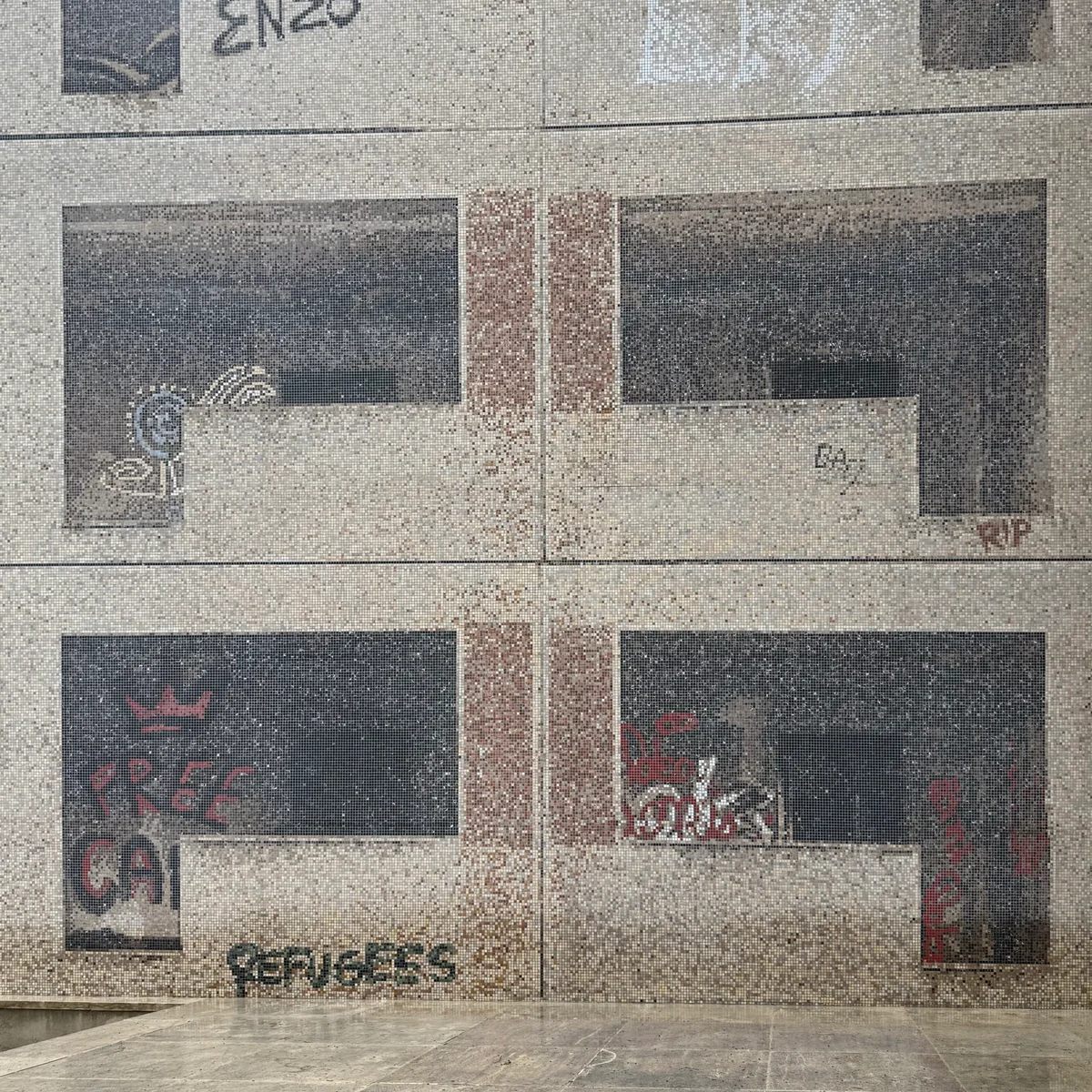
Tieu's three-million-piece mosaic cladding envelops the pavilion's exterior, obscuring its fascist architecture with an image of graffiti-covered concrete. The source: the Gehrenseestraße housing block where she grew up, now being demolished by Berlin real-estate speculators. The work is an act of additive transformation rather than erasure—she is not removing or cutting into the building, but layering another history, another set of bodies, another architecture onto it.
The mosaic's surface reads as textured, weathered, alive. Up close, the individual marble tiles vary in tone and hue, creating a pixel-like effect that captures both the brutalism of socialist prefabrication and the degradation of time. The work references the 1992 Rostock-Lichtenhagen pogrom, in which far-right mobs attacked the "Sonnenblumenhaus" (itself tiled), highlighting how immigrant communities have repeatedly been made targets of violence while the state offered no protection.
It is visually striking and conceptually devastating.
Henrike Naumann's The Home Front (Die Innere Front, 2026)
Inside, Naumann's final installation occupies the central space with an almost claustrophobic density. The walls are painted in a luminous mint-green—the exact shade used in abandoned Soviet barracks scattered across East Germany. This color choice carries prophetic weight: Naumann selected it before Russia's controversial participation in the 2026 Biennale was announced, yet it reads now as a refusal to let history settle.
The installation comprises multiple components arranged in taxonometric precision: halved chairs (vertically split furniture running along the walls like a frieze), a reworked socialist-realist mural painted by her great-grandfather Karl Heinz Jakob in 1961 (originally in Chemnitz, buried behind drywall in 2002), an anamorphic relief of a living room styled in Neues Deutsches Design but rendered in austere grays and blacks, and scattered domestic objects—keys, ornate weapons, paintings.
The effect is simultaneously maximalist (there is a lot here) and minimalist (the color palette drains vitality). It feels like an archaeological site of everyday life under totalitarianism. The halved chairs particularly resonate: they evoke Yoko Ono's conceptual strategies while indexing a divided nation through the fragment. Nothing here is homey. As curator Kathleen Reinhardt notes, "No matter how homey you attempt to be in the German pavilion, it always stays a hostile place."
Sung Tieu's Sculptural Interventions
In the side wings, Tieu presents more delicate, haunting works. They Have Eyes, But They See Not, They Have Ears, But They Hear Not (2026) comprises aluminium recasts of chocolate ladybirgs—whimsical objects rendered monumental and metallic. The title draws from biblical language about blindness and deafness, evoking both the indifference of institutions and the forced invisibility of migrant workers.
Casts of her mother's body are distributed through the space, made from glass and steel beam profiles. These fragmentary forms conjure what one critic aptly called "the dark spirit of race-obsessed biomechanics"—the way bodies become typed, categorized, controlled by bureaucratic systems.
Fragrances throughout evoke the interiors of Tieu's childhood home, engaging smell as a form of embodied memory that resists official documentation.
In Perspective
What makes Ruin remarkable is its refusal of reconciliation aesthetics. The German Pavilion has a long history of artists grappling with the building's Nazi history—Hans Haacke broke the marble floor into fissures, Maria Eichhorn attempted to make it disappear. Naumann and Tieu do something different: they occupy the space fully, claiming it as a site where multiple histories of violence, erasure, and survival intersect.
The exhibition works at the intersection of East German memory, immigrant histories, gendered domestic labor, and contemporary real-estate violence. It asks: who gets to be remembered? What happens to housing complexes built for guest workers when they're no longer economically useful? How do we honor histories the state actively suppressed?
Tieu's mosaic, in particular, is radically generous—rather than critiquing or deconstructing, it adds, honors, makes space. Yet that generosity is shadowed by the fact that the building she's memorializing is simultaneously being demolished. The work preserves something even as it vanishes. This temporal paradox sits at the heart of the exhibition.
Naumann's installation is more claustrophobic, more suffocating. It doesn't offer beauty so much as confrontation with the material residue of ideology. The mint-green walls feel like entrapment. Yet her choice to arrange objects—to take them out of storage, to display them, to make them legible—is itself a form of resistance: making the invisible visible, the forgotten remembered.
Together, the works generate what critic Rachel Wetzler called "meaning"—a rare quality in this year's Biennale. They do what art at its best does: they make historical abstraction visceral, material, undeniable.
The shadow of Naumann's death adds another layer. This installation marks a development in her practice she won't see realized. There's something both heartbreaking and fitting about that incompleteness—it mirrors the exhibition's larger themes of interrupted histories, of work left unfinished by forces beyond individual control.
Visitor Info
Dates: May 9–November 22, 2026
Hours: May 9–September 27: 11 am–7 pm | September 29–November 22: 10 am–6 pm | Closed Mondays (except May 11, June 1, September 7, November 16)
Location: German Pavilion, Giardini della Biennale, Sestiere Castello, 30122 Venice, Italy
Tickets: Available through www.labiennale.org
Getting There: ACTV water buses 1, 2, 4.1, 5.1 serve the Giardini entrance. The Arsenale venue is also accessible via the same lines.
Accessibility: The exhibition venues offer courtesy electric vehicles for visitors with reduced mobility, plus wheelchairs and walkers available on request.
This is essential viewing for anyone interested in how contemporary art engages historical trauma, migration, memory, and resistance. Expect to spend at least 90 minutes. The work demands and rewards sustained attention.