Overview
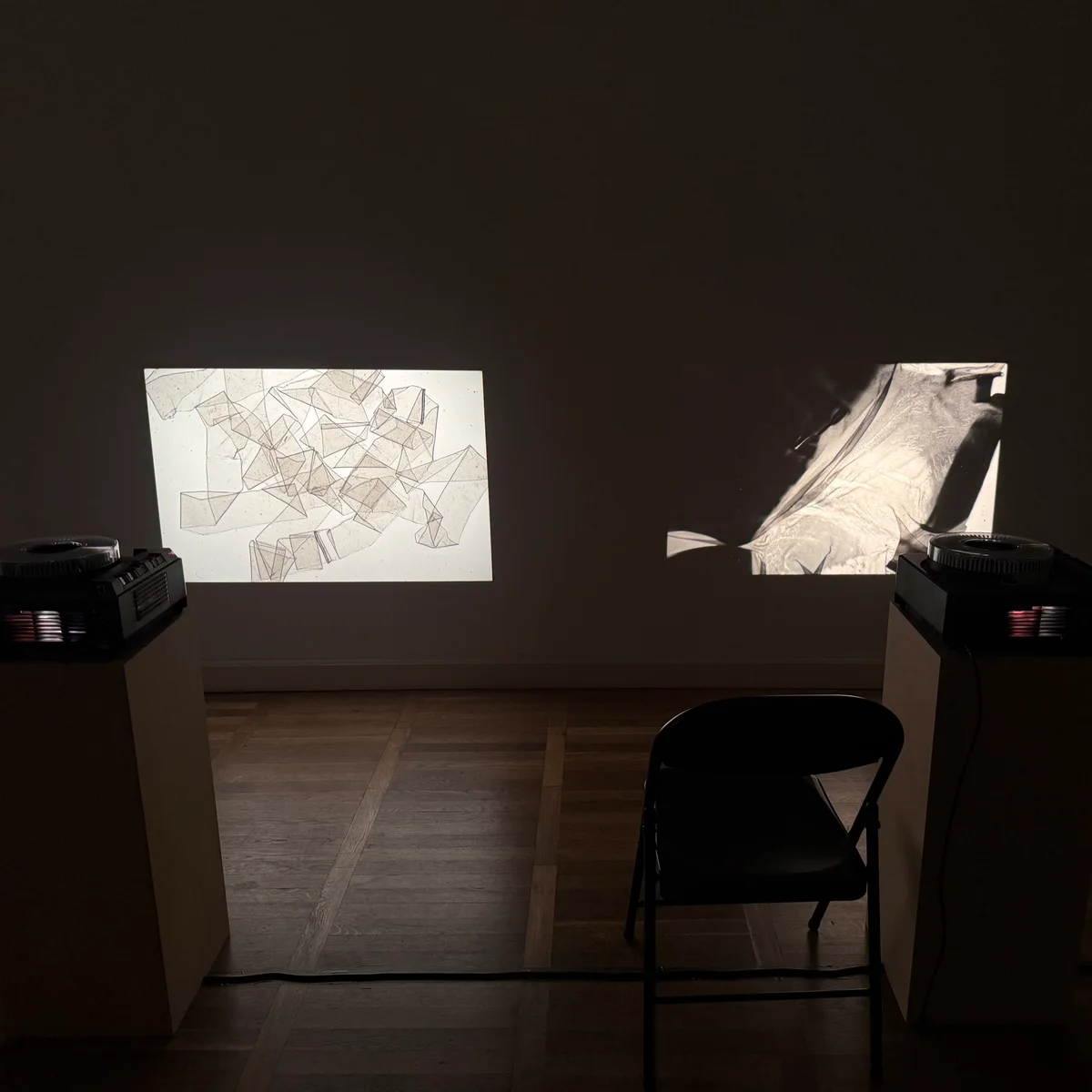
Rey Akdogan's "Carousels" at Haus am Waldsee is a quietly radical exhibition that converts the mechanical tedium of slide projection into something approaching the poetic. Working with materials sourced from film, theater, and advertising—color filters, plastic packaging, Mylar sheets, fluorescent rods—Akdogan constructs fragile assemblages within 35-mm slide frames that rotate endlessly in standard Kodak projectors. The result: images that exist not through photography but through layered materiality and transmitted light. It's conceptually rigorous without being austere, and visually compelling without spectacle.
The exhibition arrives as part of Haus am Waldsee's 80th-anniversary programming, and the venue's 1920s villa provides an architectural anchor that Akdogan cleverly engages. This is not a show that merely occupies a space; it dialogues with it.
The Artist
Akdogan (born Heilbronn, 1974) studied at Central Saint Martins in London before completing the Whitney Independent Study Program—a path that positioned her within institutional critique and material culture discourse. Her exhibition history is measured but persistent: Miguel Abreu Gallery in New York, Galerie Anke Schmidt in Cologne, smaller institutional shows at MoMA PS1 and various European venues. She has quietly built a practice that refuses easy categorization while maintaining serious intellectual rigor.
What distinguishes Akdogan is her refusal to aestheticize the mundane. She doesn't salvage materials to create beauty from waste in the romantic sense. Rather, she treats industrial materials as documents—traces of their original labor, their invisible conditioning of our visual field. In this way, her work sits somewhere between phenomenology and institutional critique, though it transcends both.
Key Works to Look For
Carousel #11 (2025-26) stands as the exhibition's centerpiece and its most successful conceptual achievement. Akdogan analyzed the geometric tile pattern of the villa's historic winter garden—a detail designed to be background, never foreground—and abstracted it into the rotating sequence of 80 slides. The pattern decomposes and recomposes with each 13-minute loop, making temporal the spatial. Accompanying light installation in the winter garden itself spotlights the actual floor tiles with sculptural precision, inverting the room's phenomenology. Where one expected views of the lake, one encounters disciplined examination of domestic infrastructure. It's a small gesture with genuine intellectual ambition.
Carousel #9 and #10 showcase earlier iterations of the series, demonstrating Akdogan's sustained investigation into color relationships and surface interaction. The transparencies layer without hierarchy—a blue filter might sit beneath crumpled packaging, which overlays a section of cinefoil. The projected image registers these strata as rhythmic structures, sometimes linear, sometimes approaching near-abstraction. They're hypnotic without being hypnotizing in the intended sense; you're mesmerized by process, not narrative.
Slit Drape (C) (2026), the outdoor bronze tinsel curtain, provides necessary counterpoint. While the carousel works demand darkened rooms and patient looking, this piece shimmers and moves with any breeze—alive in a way the projections are not. It's a moment of release, though characteristically controlled. Akdogan doesn't seek catharsis.
In Perspective
This exhibition's strength lies in its conceptual coherence and its refusal to oversell its own stakes. Akdogan doesn't claim the carousel works reveal hidden truths about vision or late capitalism, though both could be argued. Instead, she presents a careful analysis: here are materials designed to be invisible; here is what happens when we make them visible; here is how context determines perception. It's modest without being timid.
The limitation, frankly, is accessibility. The work demands time and a certain meditative capacity that not all visitors possess. The darkened rooms, the hum of projectors, the subtle shifts in color and rhythm—these can feel like endurance tests rather than invitations. A viewer spending five minutes may find the work austere or even empty. One spending thirty minutes enters a different register of experience. Haus am Waldsee's complementary programming (slow-looking workshops, guided tours) acknowledges this, but the work itself offers no guardrails.
There's also a question of whether the Carousel series, compelling as individual works, accumulates meaningfully as a collective presentation. Multiple rooms of rotating projections begin to blur into one another. The "polyphonic installation" aims for simultaneity and rhythm, but the effect sometimes reads as redundant rather than symphonic.
Yet these are quibbles with an exhibition that takes itself seriously and rewards serious engagement. In an era of content-driven art, Akdogan's insistence on material specificity and durational looking feels genuinely countercultural.
Visitor Info
Open Tuesday–Sunday, 11 AM–6 PM through May 25, 2026. The venue is located in Berlin's Grunewald district, a 20-minute journey from central Berlin by public transport. The exhibition is housed in a historic villa with limited accessibility; contact the venue regarding specific needs. Plan for at least 60–90 minutes to engage meaningfully with the work. The accompanying sculpture park and café provide respite and extend the visit into a half-day or full-day outing. Slow-looking workshops are available for those seeking guided framework for the experience.