Overview
Matthias Noggler's The Uselessness of Defense arrives as a deceptively simple yet intellectually rigorous interrogation of how artistic form can neutralize ideological content. Presented in the sacred space of St. Andrew's Church in Salzburg through August 2026, the exhibition takes the pistol—perhaps the most culturally overdetermined symbol of violence and power in contemporary image culture—and systematically dismantles its authority through repetition, deformation, and chromatic abstraction.
The core premise is elegant: by depicting weapons in progressive states of dissolution, Noggler demonstrates that even the most symbolically charged objects can be rendered "useless" through aesthetic transformation. This is not merely formal play; it's a serious engagement with how images shape consciousness and how artists might ethically challenge embedded meanings.
The Artist
Matthias Noggler (born 1990) represents a generation of Austrian painters who navigate fluidly between figuration and abstraction, treating visual culture as a landscape to be excavated and reconstructed. Educated at the Academy of Fine Arts Vienna under Silke Otto Knapp and Julian Göthe, Noggler has developed a practice that examines the ideological functions of images across high art, commercial design, and vernacular visual traditions.
His earlier work focused on figurative depictions of social conflict and group dynamics—scenes of urban alienation rendered with expressionistic intensity. In recent years, he has shifted toward exploring architectural spaces and, now, toward the serial deconstruction of loaded symbols. His representation by Layr (Vienna) and DREI (Cologne) signals his integration into Europe's contemporary gallery circuit, though his engagement with public and sacred spaces suggests ambitions beyond the white cube.
Key Works to Look For
The exhibition centers on large-scale paintings executed in gouache and color pen on canvas, with dimensions reaching 200×200 centimeters—a scale that positions these deconstructed weapons as monumental, almost architectural presences.
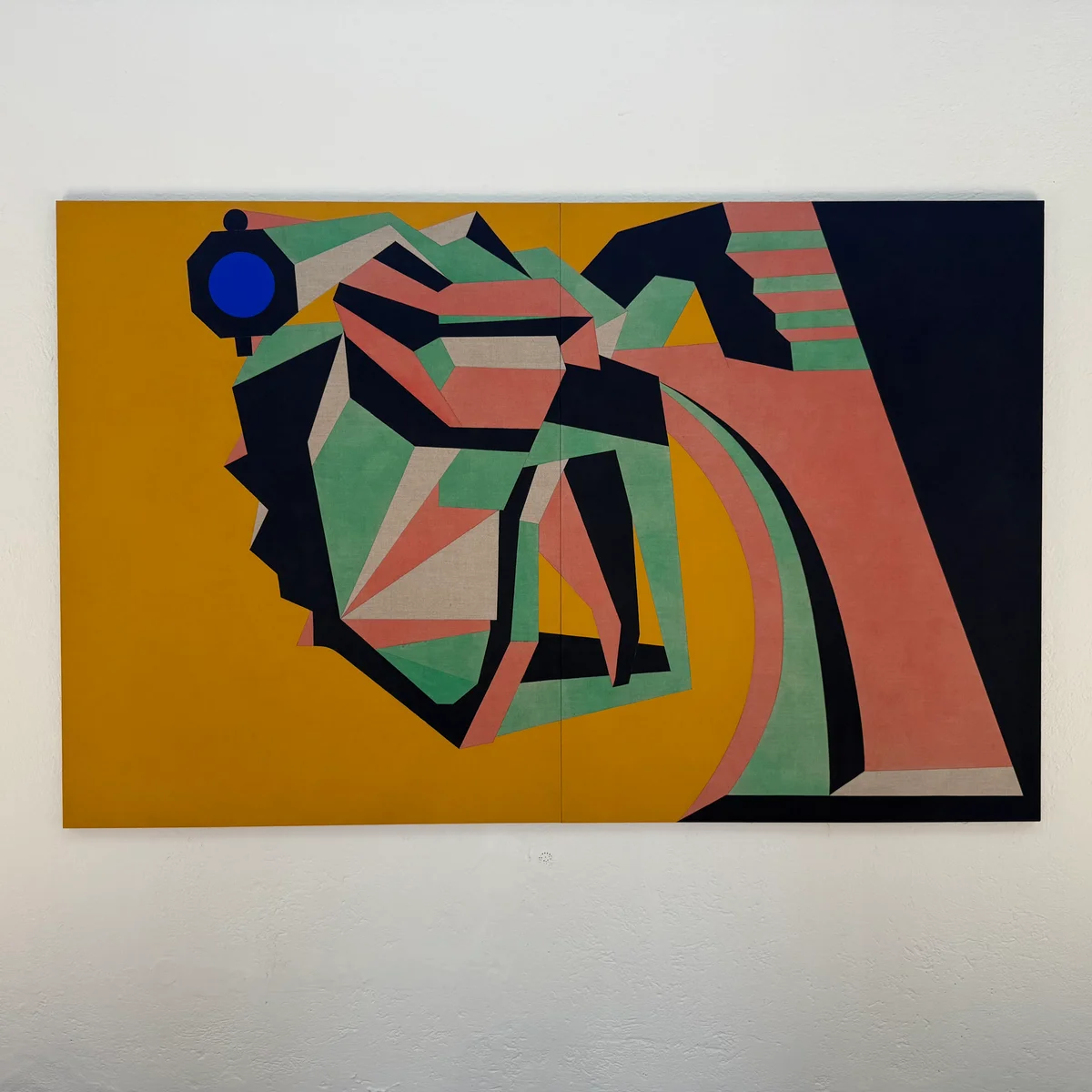
Untitled (2025), the work documented in exhibition materials, exemplifies Noggler's approach. What begins as a recognizable pistol—cylinder, barrel, grip—undergoes systematic transformation: it stretches and compresses, becomes cartoonishly distorted, and ultimately dissolves into segmented planes of color. The forms are rendered in bright primaries against ochre or neutral grounds, a chromatic strategy borrowed from Pop Art but applied with the severity of modernist abstraction.
The power lies not in individual works but in seriality. Viewing these paintings sequentially reveals Noggler's conceptual method: each canvas represents a stage in the weapon's formal disintegration. By the final works, the pistol has ceased to function as a recognizable object and has instead become an excuse for exploring abstraction itself—prismatic fractured forms and sharp compositional contrasts that echo both Cubist church art and commercial supergraphics.
What strikes most forcefully is the absence of menace. These are not threatening weapons rendered grotesque for shock value. Instead, they are silly, limp, and increasingly alien—more curious than monstrous. Some canvases feature the deconstructed forms turning directly toward the viewer with an almost character-like presence, as if the abstraction itself has acquired agency.
In Perspective
Noggler's exhibition engages seriously with Pop Art's strategy of elevating mass-produced commodities to high art status—but with a crucial difference from Warhol's glamorization. The pistol here is not celebrated; it is systematically defanged. This represents a more ethically conscious application of Pop sensibilities, suggesting that repetition and formal transformation can neutralize rather than amplify cultural meaning.
The decision to exhibit in a church is neither neutral nor decorative. By positioning these works in sacred space, Noggler invokes the tradition of Orthodox iconography, which strips figures of corporeality and converts them into symbolic signs. The parallel is deliberate and provocative: the pistol, rendered abstract, begins to function like an icon—a sign pointing toward something beyond itself, though in this case toward its own uselessness rather than toward transcendence.
Yet the exhibition is not without limitations. The conceptual framework, while intellectually sound, is somewhat familiar territory in contemporary art discourse. The idea that abstraction can neutralize ideological content has been explored extensively since at least the Cold War period. Noggler executes this idea with skill and visual sophistication, but the exhibition does not substantially advance the conversation beyond established positions.
Furthermore, there remains a tension between the exhibition's utopian premise—that aesthetic transformation can render violence symbolically "useless"—and material reality. In a world where firearms continue to proliferate and claim lives, the claim that paint can neutralize their ideological force risks appearing aestheticized or disconnected. Noggler's work succeeds as formal inquiry but remains ambiguous as social intervention.
The church context ultimately becomes the exhibition's most intellectually interesting element, suggesting that the artist understands his work not as solving the problem of violent imagery but as creating a space where such images can be contemplated, questioned, and formally undone—a modest but genuine contribution.
Visitor Info
Exhibition: Matthias Noggler: The Uselessness of Defense
Dates: July 25 – August 30, 2026 (Opening reception: Friday, July 24, 2026, 6–8pm)
Location: St. Andräkirche / St. Andrew's Church, Mirabellplatz 5, 5020 Salzburg, Austria
Hours: Tuesday–Saturday, 11:00am onwards
Phone: +43 662 8047 805210
Gallery: Represented by Layr
The Gothic church, originally built in the 1410s and positioned prominently in front of Mirabell Palace, regularly hosts cultural and artistic events beyond its liturgical functions. The venue is centrally located and accessible within Salzburg's compact cultural landscape. The exhibition offers an extended engagement with Noggler's conceptual project through late summer, providing ample opportunity for repeated viewing—itself an important aspect of experiencing the serial logic of the work.