Overview
Panthalassa, J. Parker Valentine's fifth solo exhibition at Galerie Max Mayer in Berlin, takes its conceptual anchor from an ancient geological era—the superocean that once surrounded the primordial Earth. The show runs through August 22, 2026, and marks a significant evolution in Valentine's practice, extending her investigations of perception and materiality into the gallery's exterior courtyard for the first time. The exhibition presents new drawings and bronze sculptures, alongside installations that blur the boundaries between artistic intervention and environmental transformation.
The Artist
J. Parker Valentine, born in 1980 in Austin, Texas and now based in Los Angeles, has built a reputation for rigorous, process-driven work that resists easy categorization. Her multidisciplinary practice—spanning drawing, sculpture, and installation—is grounded in what she calls the "principal activity of drawing," though her works consistently challenge what drawing can encompass. Valentine's career includes exhibition history at major institutions and galleries worldwide, from the Langen Foundation to the Museum of Contemporary Art Detroit, and she maintains an ongoing relationship with Galerie Max Mayer that extends back to 2018. Her work is characterized by a resistance to language and form, even as it engages both with deliberate intentionality.
Key Works to Look For
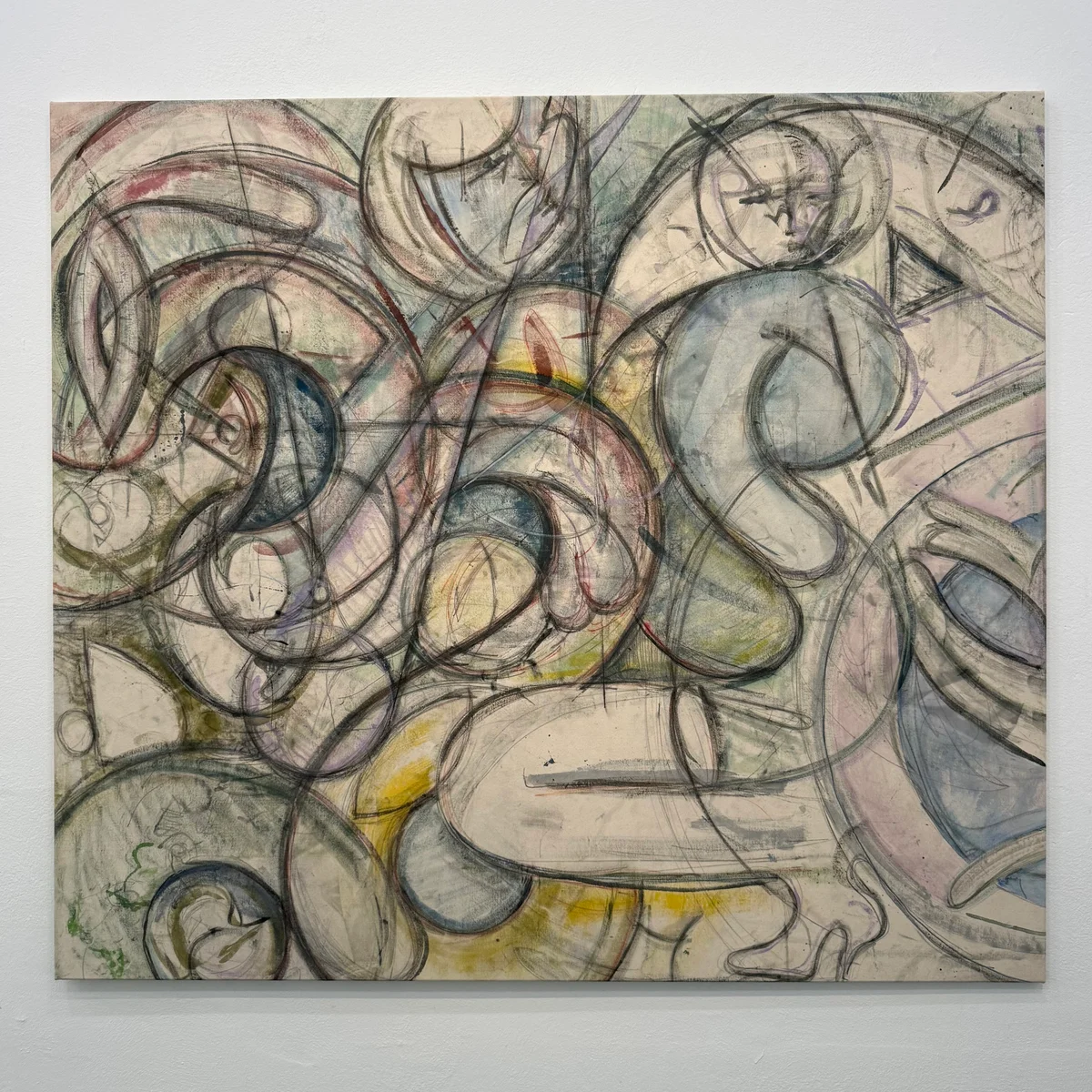
The conceptual core of Panthalassa emerges from a series of large-scale canvases developed over many months through an accumulative process. Valentine cuts, washes, rearranges, and redraws these surfaces, leaving visible traces of previous states embedded within the woven canvas. The resulting works oscillate between abstraction and figuration—images that seem to shift with each encounter, refusing stable identity. This approach yields compositions with genuine visual complexity; the eye continues to discover new readings rather than settling into resolved meaning.
A rotating sculptural work deserves particular attention. Its circular motion draws the viewer's gaze into a tunnel-like depth, evoking cycles of time and evolutionary becoming. This kinetic element transforms how one experiences the static works surrounding it, introducing temporality and change as active formal concerns.
The courtyard intervention represents the exhibition's boldest gesture. A bronze sculpture wraps around an existing tree, creating a deliberate ambiguity between sculptural object and natural growth. This work succeeds most when it generates genuine uncertainty—a moment where the viewer cannot immediately parse where human intention ends and organic form begins. It's an ambitious move that doesn't always land with equal force, but the willingness to risk it speaks to Valentine's commitment to dissolving categorical boundaries.
In Perspective
Panthalassa consolidates concerns that have animated Valentine's practice for years while pushing toward new formal territory. Her engagement with the palimpsestic canvas—where earlier states remain visible—connects to broader contemporary interest in artistic process as content. Yet Valentine's execution here feels more assured than in some previous iterations; the works possess a visual authority that justifies their material complexity.
The title's invocation of geological deep time gives the exhibition a conceptual ambition that occasionally outpaces the work itself. The connection between ancient ocean and contemporary perception isn't always organically realized in the visual experience. Some drawings read as exercises in material manipulation rather than profound investigations; the intellectual framework sometimes feels imposed rather than discovered through formal engagement.
That said, the courtyard works and the rotating sculpture indicate Valentine moving toward a more integrated spatial practice. These pieces achieve something her wall-based work sometimes strains toward: a genuine dissolution of boundaries, a space where transformation feels actively present rather than theoretically invoked. The exhibition works best when visitors move through it physically, when the rotating sculpture alters their perception of surrounding works, when the courtyard bronze generates that moment of visual uncertainty.
In an era when so much artistic practice has become didactic or explicitly political, Valentine's resistance to narrative clarity and stable meaning reads as genuinely countercultural. Whether this resistance ultimately serves deeper investigation or merely defers meaning remains open to interpretation—perhaps intentionally so.
Visitor Info
Location: Galerie Max Mayer, Hardenbergstraße 9a, 2nd backyard, Berlin
Hours: Wednesday–Saturday, 11:00 AM–6:00 PM
Exhibition Dates: July 2–August 22, 2026
Website: www.maxmayer.net
The gallery's second-courtyard location requires intentional navigation; allow time to locate the entrance. The courtyard installation rewards a full walk-through of the outdoor space.