Overview
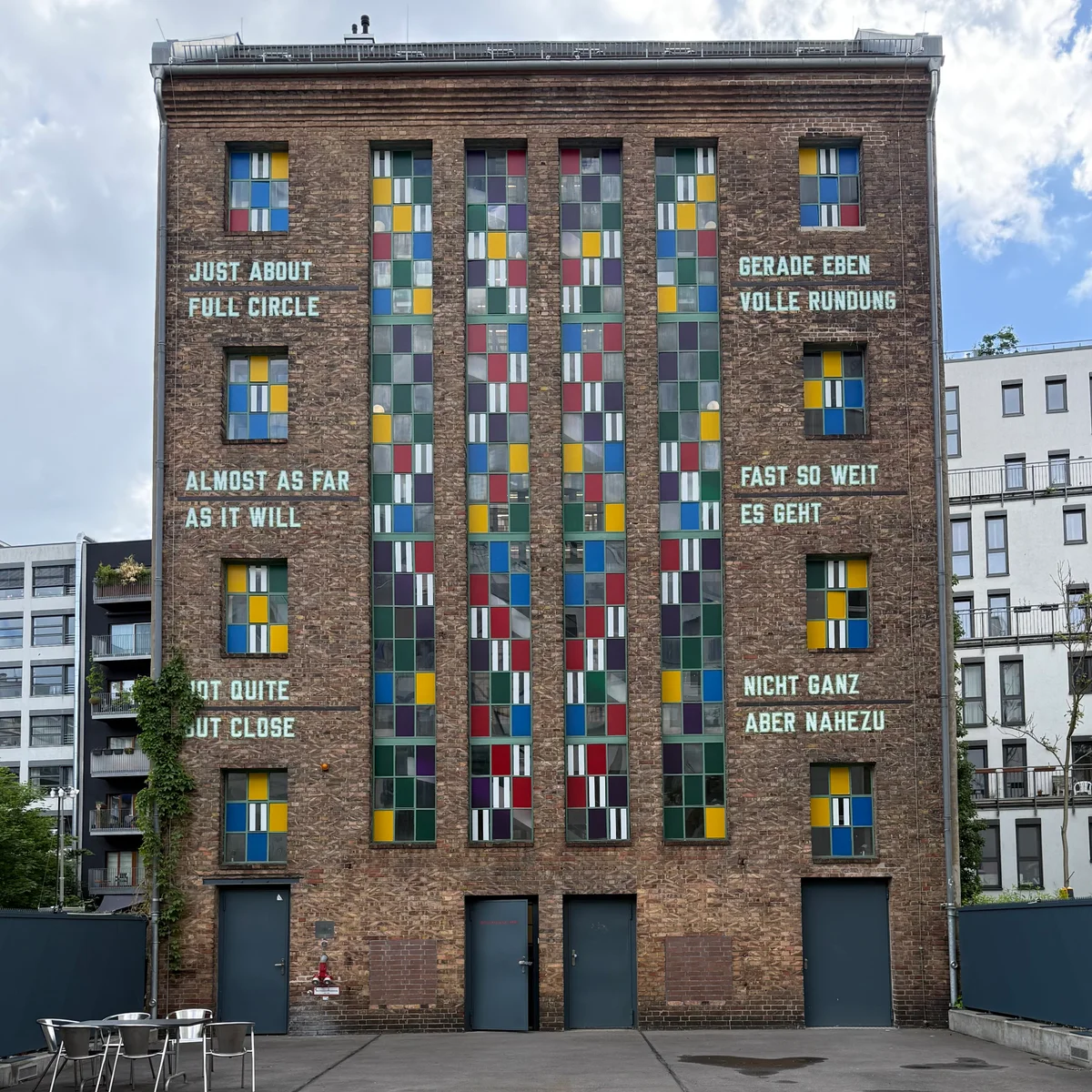
Daniel Buren's return to Konrad Fischer Galerie marks a watershed moment in the artist's five-decade relationship with the legendary gallery. Opening during Gallery Weekend Berlin 2026, "Trois en Un, hauts-reliefs, travaux situés" presents new monumental works that consolidate Buren's most essential preoccupations: the collapse of boundaries between art object and architectural space, the serial interrogation of form, and the viewer's complicit role in activating meaning.
This is Buren's first exhibition in the gallery's current Neue Grünstraße location, and the artist has responded characteristically—not with works confined to white walls, but with pieces that breach the interior entirely, extending across facade and street.
The Artist
Daniel Buren (b. 1938) remains one of conceptual art's most uncompromising practitioners. Since the 1960s, his signature 8.7-centimeter-wide vertical stripes have functioned as both visual signature and philosophical tool—a standardized module that paradoxically generates infinite variation depending on context.
The artist's collaborative history with Konrad Fischer stretches back to 1969, when a groundbreaking Düsseldorf exhibition spilled across the entire city, transforming advertising pillars and street corners into exhibition sites. That early work established Buren's core methodology: the artwork is never autonomous, but always situated—always in dialogue with its surroundings.
Buren's institutional credentials are impeccable. He received the Venice Biennale's Golden Lion in 1986, the Praemium Imperiale in 2007, and has sustained major retrospectives at the Guggenheim, Centre Pompidou, and Fondation Louis Vuitton. Yet his practice resists canonization. Unlike many celebrated conceptualists, Buren continues to produce works that genuinely interrogate their display conditions rather than merely documenting past interventions.
Key Works to Look For
The centerpiece comprises a series of large-scale circular mirror surfaces, each exceeding two meters in diameter. These are not decorative objects; they are phenomenological instruments.
The mirrors function as active agents. By capturing the building's architecture, the gallery's interior dimensions, and crucially, the viewer's own reflected image, these works collapse the traditional separation between subject and object. You don't observe the work—you become part of it. Your body, the gallery's proportions, and Buren's formal system enter into a continuous negotiation.
This strategy extends Buren's established practice of exploiting site-specificity, but with a significant evolution. Earlier works employed the stripe as a neutral overlay that revealed a space's existing conditions. These mirrored discs, by contrast, actively reconstruct spatial experience through reflection. The repetition and subtle variation among the pieces maintain Buren's commitment to serial logic—the idea that formal reduction enables rather than constrains visual diversity.
Crucially, the gallery facade participates in the exhibition. This deliberate inclusion signals that Buren considers the boundary between interior and exterior as another convention to interrogate. The works don't merely sit inside a gallery; they assert the gallery's architectural envelope as part of their conceptual apparatus.
In Perspective
Buren's practice emerged in direct opposition to the object-fetishism that dominated 1960s art discourse. His stripes explicitly rejected the notion of art as autonomous commodity. Yet fifty years later, with Buren's works in major collections and commanding significant prices, a complicated situation has developed: the anti-institutional gesture has become institutionalized.
This exhibition navigates that paradox with reasonable success. By insisting that his new works extend across the facade and implicate the viewer's presence, Buren resists the comfortable domestication that befalls most museum-canonized artists. The mirrored surfaces feel genuinely experimental rather than retrospective, suggesting the artist hasn't retreated into nostalgic repetition of earlier strategies.
That said, one wonders whether site-specificity—that generative concept of the 1970s—retains its critical force when practiced by a canonized master within an established gallery context. Buren is aware of this tension. His work persistently raises the question without pretending to resolve it. That intellectual honesty distinguishes his practice from artists who've simply applied period techniques to contemporary settings.
The exhibition's title, "Trois en Un" (Three in One), suggests a trinity—likely referencing the work's integration of gallery interior, facade, and public space. It's characteristically economical nomenclature, dense with conceptual weight.
Visitor Info
Exhibition: Daniel Buren: Trois en Un, hauts-reliefs, travaux situés
Venue: Konrad Fischer Galerie, Neue Grünstraße 12, 10179 Berlin
Dates: 1 May – 1 August 2026
Opening: 1 May 2026, 6–9 pm (Gallery Weekend Berlin)
Weekend Hours: Saturday–Sunday, 11 am–6 pm
Contact: +49 (0) 30 5059 6820
The exhibition opens during Gallery Weekend Berlin's 22nd edition, making this an opportune moment to experience Buren's work alongside contemporary discourse. Plan to spend time with the mirrored surfaces—their effects shift subtly as you move through the space and as ambient light changes. Bring awareness of your own reflection; it's not incidental but central to the work's meaning.