Overview
C.B. Evans has brought a provocative first solo exhibition to Berlin's Schinkel Pavillon—a darkened, cinematic interrogation of how digital systems and entertainment industries manufacture reality itself. Reality or Not centers on a 35-minute film work (2023) that traces a group of Parisian teenagers as they navigate between competing "levels" of reality within a reality TV show framework. It's a work that uses humor, collage, and pop culture to ask urgent questions about narrative control, algorithmic mediation, and who gets to define what's real.
The exhibition arrives at a moment when questions about artificial intelligence, deepfakes, and algorithmic image economies feel less abstract and more visceral than ever. Evans doesn't pretend to have answers—instead, she maps the terrain of contemporary confusion with considerable wit and emotional intelligence.
The Artist
Cécile B. Evans is an American-Belgian artist based in Saint Denis whose practice excavates the relationship between emotion and systems of control. She has described her approach as "compassionate pessimism"—a refusal of both naive optimism and pure dystopian collapse. Her work has circulated through major institutions: Centre Pompidou, Tate Liverpool, Whitechapel Gallery, the Sydney Biennale, and Berlin's own Gropius Bau.
What distinguishes Evans is her willingness to work across mediums—film, sculpture, installation, performance—without sacrificing conceptual rigor for spectacle. In 2024, she created RECEPTION!, an AI-generated commission for Miu Miu's Paris Fashion Week show, which then fed back into a larger question about memory, translation, and the last human voices in algorithmic systems. She moves between fashion houses and art institutions with the same critical distance, never fully at home in either.
Key Works to Look For
The Film: Reality or Not (2023)
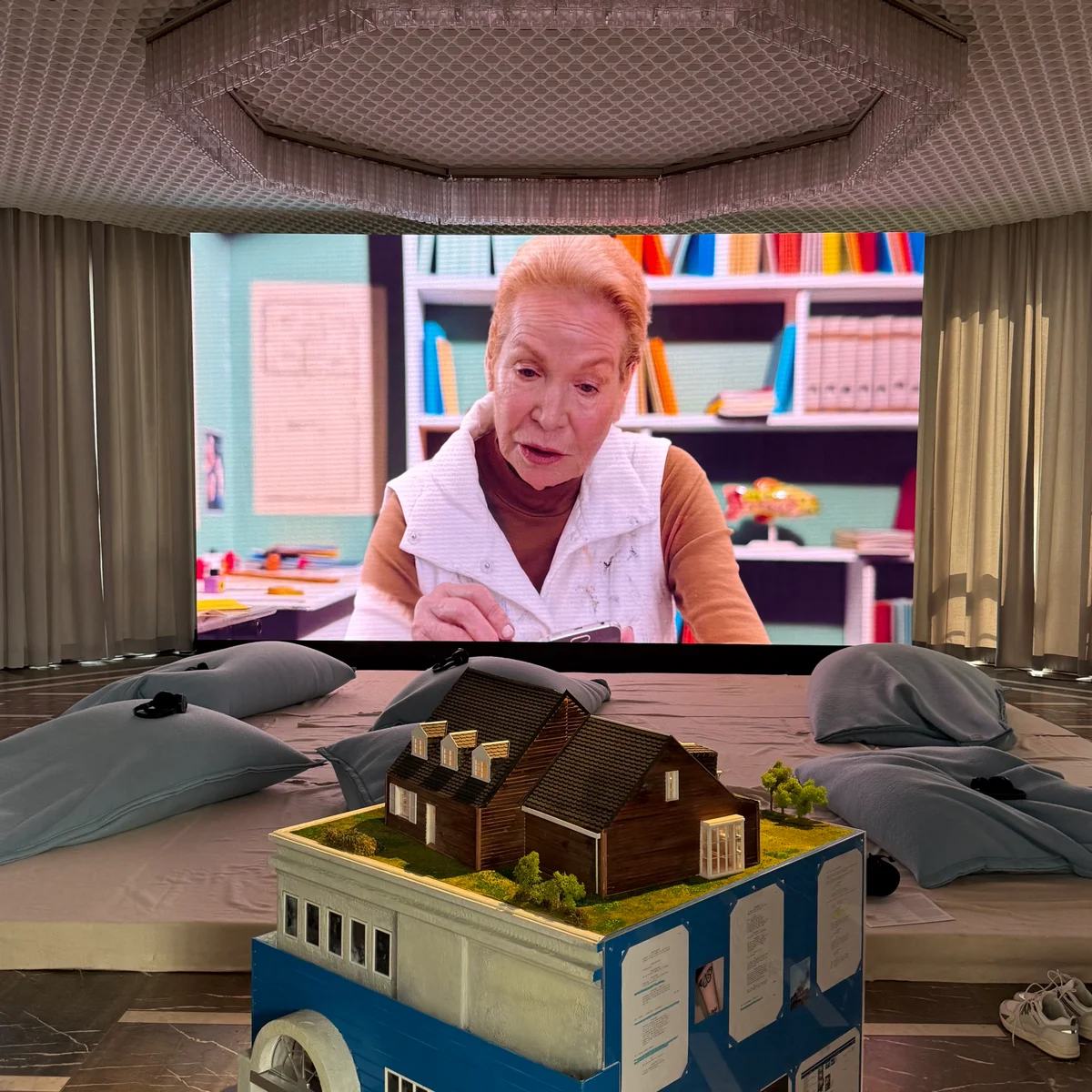
The centerpiece is the film itself, and it rewards sustained attention. Shot in a hybrid style mixing documentary footage, staging, and animation, it follows young people from Seine-Saint-Denis as they question the nature of reality TV and the stories told about them. There's genuine affection here for these characters, alongside sharp critique. Evans doesn't position them as victims of algorithmic capture so much as agents trying to forge their own narratives within constrained systems.
The 35-minute duration is deliberate—long enough to settle into the work's rhythms, short enough to loop continuously without exhausting the visitor. The film doesn't resolve; it expands outward, multiplying possibilities rather than closing them down.
The Platform: To rebuild the sky with the ruins of a violent history
This is the exhibition's most conceptually audacious gesture. The viewing platform is constructed from British and Dutch NATO military blankets—objects with deep Cold War history, now repurposed as furniture for watching a film about reality production. The discomfort (the blankets don't offer great lumbar support) is intentional. You're literally sitting on the materialized history of military alliance, bearing its weight while consuming contemporary media. It's conceptual art with a physical toll.
The Ad Hoc Order Sculptures (2024)
These mixed-media assemblages—combining acrylic, laser-cut materials, wood, 3D-printed polymers, concrete, stone, and found objects—feature devastatingly long titles: Your collapse was witnessed, your destruction cataloged and banked at the wreckage of the hope meant to heal you. Every fibre will be used to knit a duvet.
The sculptures themselves are architectural, somewhat austere, but the titles transform them into monuments to failure, loss, and the bureaucratic recording of suffering. They propose that even destruction can be repurposed, recycled, made into something serviceable. It's bleak and oddly generative at once.
In Perspective
Where Reality or Not excels is in its refusal of easy targets. This isn't a screed against social media or Silicon Valley excess. Instead, Evans acknowledges that algorithmic systems and reality TV formats exist because they answer real desires—for visibility, narrative, control over one's own story. The teenagers in her film aren't dupes; they're trying to weaponize the format against itself.
The exhibition's political consciousness is real but ungrandstanding. By centering voices from the Parisian banlieue—communities routinely excluded from mainstream narratives—Evans makes visible the stakes of who controls reality production. But she trusts the work's intelligence to speak for itself rather than hectoring viewers into correct interpretation.
One minor caveat: the film's conceptual richness doesn't always translate into formal innovation. The aesthetic is deliberately flat, collage-like, which serves the work's themes but can feel thin at moments. The animation sequences occasionally feel generic. This is perhaps intentional—a refusal to aestheticize or beautify the systems being critiqued—but it occasionally flattens what could be more visually surprising.
What lingers is the architecture of the whole: the darkened pavilion, the NATO blankets underfoot, the looping film, the sculptural debris. It's a carefully constructed environment that makes the exhibition function as total experience rather than discrete artworks. That's where Evans' real strength lies—in orchestrating how meaning circulates through space, material, and time.
Visitor Info
Hours: Thursday–Friday, 2pm–7pm; Saturday–Sunday, 11am–7pm
Admission: €6 (€4 reduced); card payment only
Location: Schinkel Pavillon, Oberwallstraße 1, 10117 Berlin-Mitte
Contact: +49 30 20886444 | info@schinkelpavillon.de | www.schinkelpavillon.de
The Schinkel Pavillon itself—a 1969 modernist structure designed by Richard Paulick—is worth experiencing. For this exhibition, the high windows are darkened to optimize the cinematic experience, creating an intimate, almost bunker-like atmosphere. Allow at least 45 minutes to catch the full film and sit with the installation. The exhibition runs through August 31, 2026.